
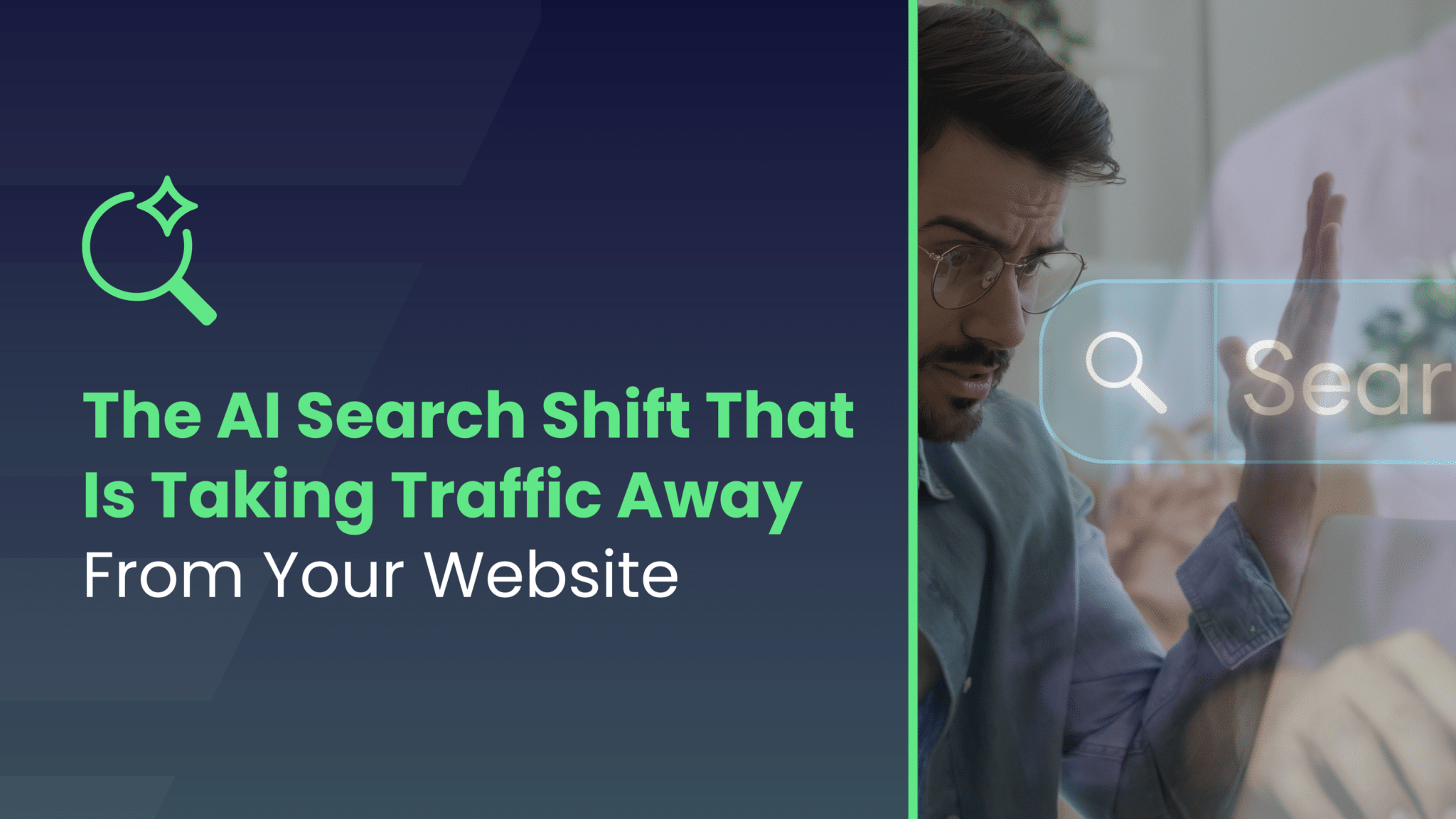
AI search is not killing your brand visibility: it is changing where that visibility occurs. Many mid-market companies are still measuring digital success with a 2015 search engine optimization (SEO) dashboard while competing in a complex 2026 search ecosystem. If you are judging your market influence solely by the volume of monthly visitors arriving at your website, you are missing the real shift in how modern business leaders discover vendors, products, and services.
The traditional marketing funnel used to be incredibly straightforward: a user performed a search, clicked on a blue link, landed on your website, and entered your sales pipeline.
Generative artificial intelligence (AI) has inserted a permanent new layer into this process:
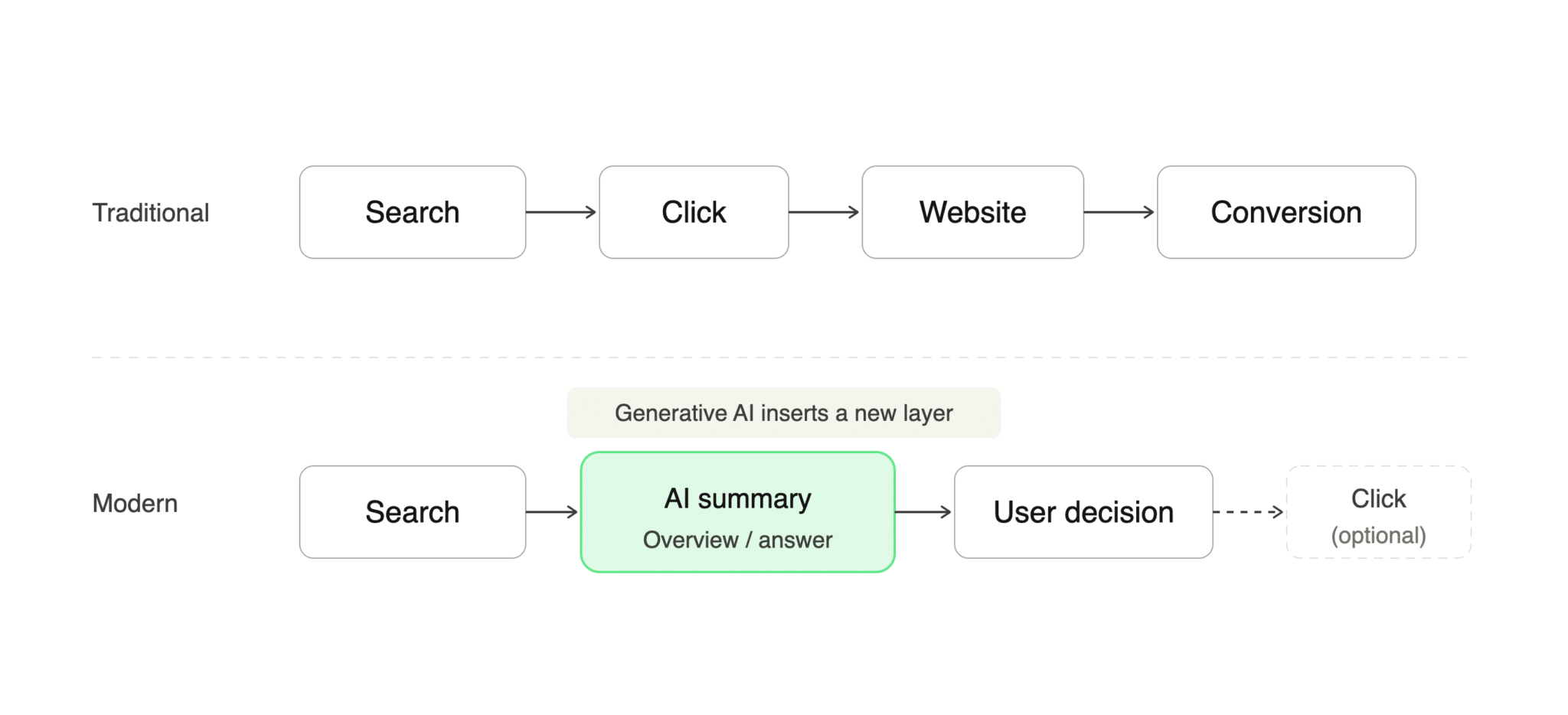
When Google AI Overviews, Perplexity, or ChatGPT answer an informational query completely inside the search interface, the user gets exactly what they need without ever leaving the platform. This is the reality of the zero-click web. A business can easily lose 30% of its traditional blog traffic while simultaneously becoming far more influential in final purchase decisions. The strategic goal is no longer about maximizing raw website sessions. The real goal is ensuring your brand is the primary source influencing the buyer before a click ever happens.
The Illusion of Declining Search Visibility
When executives look at their analytics and spot a steady dip in organic traffic, the immediate reaction is panic. The assumption is that the company is losing its competitive edge or that the marketing team is failing. In reality, your target audience has simply changed its behavior. They are extracting answers directly from AI summaries, consuming the exact data points they need in real time.
This behavioral shift changes how we must view brand equity and value creation. For two decades, corporate marketers treated website clicks as the ultimate metric. In an answer engine optimization (AEO) world, immense economic value is generated through two distinct mechanisms.
- Authority Transfer: When an AI answer engine repeatedly synthesizes complex industry questions and explicitly cites your proprietary framework, data, or executive commentary as the source, the user instantly associates your brand with category leadership. If a user asks an engine how to manage cloud infrastructure technical debt, and the generated summary relies on your architectural definitions, you have won the intellectual battle long before a sales call is scheduled.
- Mental Availability: Corporate buyers do not buy from brands they do not remember. AI search engines function primarily as recommendation layers. When your business is consistently baked into the answers provided to industry researchers, your brand becomes the default recommendation. This consistent positioning creates brand recall and category trust, which ultimately drives future direct, branded traffic when the prospect is finally ready to buy.
The modern customer journey is no longer linear. An executive uses an AI tool to solve a high-level operational problem, memorizes the brand consistently cited as the authority, and then types that brand name directly into a browser weeks later to sign up for a consultation. The initial touchpoint left zero footprints on your organic blog traffic report, yet it fully generated the revenue.
The Invisible Blind Spot of Mid-Market Competitors
The dangerous blind spot for most middle-market companies lies in who they are writing for. Most marketing teams are still optimizing exclusively for traditional search engine crawlers, trying to match basic keywords and clear technical checklists. Their top-tier competitors have quietly shifted to optimizing for complete AI comprehension.
| Optimization Layer | Traditional SEO Focus | Modern AEO/AI Focus |
| Primary Audience | Search Engine Bots (Indexing) | Large Language Models (Comprehension) |
| Content Priority | High-volume keywords, generic guides | Original data, benchmarks, entity relationships |
| Technical Moat | Meta tags, basic URL architecture | Schema markup, structured data, topic clusters |
| Core Metric | Keyword rankings, website sessions | Brand citation share, branded search volume |
Traditional SEO asks a basic question: can a search engine index my webpage? AI optimization asks a far more sophisticated question: can a large language model (LLM) confidently understand, trust, and explicitly cite my expertise?
Many organizations are still publishing generic, marketing-heavy articles that are completely thin on actual insights. While a human reader might find the text readable, an LLM views it as low-value white noise. Advanced organizations are actively building entity authority instead. They use precise topic clustering and explicit schema markup to map out exactly who they are, what specific niches they own, and how their corporate expertise relates to broader industry concepts. They are feeding the machines structured, undeniable authority.
The Playbook for Category Ownership
If your organic web traffic is declining due to systemic changes in search behavior, you must execute a structural pivot across your digital footprint.
1. Become a Primary Source, Not a Summary Publisher
AI systems prefer pulling information from the original creators of data rather than platforms that simply summarize existing facts. If your content team is producing generic articles like “5 Tips for Corporate Cloud Migration,” you will be completely ignored by AI summaries.
Instead, your content must pivot to proprietary research, specialized benchmarks, and deep expert commentary. A report titled “Analysis of 400 Enterprise Migrations Highlights the Primary Causes of Post-Launch Latency” provides real, un-copyable value. The companies that create raw facts get cited: the companies that repeat them disappear.
2. Structure Content Explicitly for Generative Retrieval
LLMs do not scan your website the way human eyes do. They look for clean semantic blocks and explicit information structures. To ensure your insights are easily extracted and referenced inside AI summaries, you must format your digital assets with absolute clarity:
- Lead with the Core Answer: State your primary conclusion, metric, or resolution within the first 60 words of a topic block.
- Deploy Direct Q&A Formatting: Utilize clear H2 and H3 headings phrased as direct questions, immediately followed by authoritative, highly specific answers.
- Embed Structured Data: Implement advanced schema markup (including Article, FAQ, and Organization schemas) to clarify your author attribution and data relationships to AI scrapers.
The New Executive Marketing Matrix
You cannot manage what you do not accurately measure. If you continue evaluating your marketing department solely on standard organic traffic sessions, you will force them to chase decaying metrics. Modern executives must replace old traffic trackers with a matrix built for the AI search era.
- KPI 1: AI Citation Share: You must actively monitor how frequently your company name, proprietary tools, or executive viewpoints appear in AI Overviews, Perplexity summaries, and ChatGPT answers relative to your top three competitors. This metric is the modern equivalent of local search rankings.
- KPI 2: Branded Search and Direct Growth: When AI tools successfully recommend your business to high-intent buyers, your traditional informational traffic will drop, but your high-intent direct traffic will climb. Track searches for your precise company name, your unique product lines, and direct URL entries.
- KPI 3: Topic Ownership Score: Identify the five core operational nodes that truly drive revenue for your business. Measure your aggregate visibility across those specific topic clusters inside AI answer engines. Your long-term goal is to make your brand completely synonymous with the category itself.
The open web is not closing, but the mechanics of discovery have fundamentally broken away from the old playbook. The business leaders who win the next decade will stop fighting the drop in website clicks and start focusing entirely on dominating the answers
Self Diagnosis: Your Generative Authority
Are you adapting to the new AI search ecosystem, or are you still measuring success with a 2015 marketing dashboard? Use these five questions to determine if your brand is becoming a cited authority or disappearing into the white noise.
5 Quick Questions:
-
- 🗹
Do you measure marketing success by monitoring your “AI Citation Share” and direct branded search volume, rather than panicking over a natural decline in traditional website traffic? - 🗹
Is your content team publishing proprietary research, original data, and executive commentary, rather than generic keyword articles that AI models ignore as “white noise”? - 🗹
Have you implemented advanced schema markup and structured data to ensure Large Language Models can easily map your expertise and entity relationships? - 🗹Do you format your digital assets with direct Q&A headings and clear semantic blocks to feed AI answer engines exactly what they need?
- 🗹Does your leadership team understand that AI platforms are now “recommendation layers,” and that being the cited authority generates revenue even if it results in zero initial website clicks?
- 🗹
The Verdict:
- 4–5 “Yes” answers: You have Generative Authority. You are successfully navigating the zero-click web. Because you are feeding AI models original, structured data, you are becoming the definitive, trusted answer for your entire industry.
- 0–3 “Yes” answers: You are stuck in the Traditional SEO Trap. You are likely wasting budget optimizing for search engine bots rather than AI comprehension. If you continue publishing generic summaries instead of proprietary insights, your brand will become completely invisible to the modern buyer.