
To reach decision makers in a B2B buying committee, map the buying committee by role, not by job title. Then reach the whole account, not just the one person who filled in your form. Target the company on LinkedIn so every stakeholder sees you, and give your champion a one-page business case they can forward internally. You are selling consensus, not a product.
The person who fills in your form is almost never the person who signs.
The Deal That Died Without a Rejection
You know this deal. The demo went well. The champion was enthusiastic. They used the word “we” a lot.
Then nothing.
No rejection. Just a slow fade and a polite note about revisiting it next quarter.
Most business owners assume they lost to a competitor. Usually they did not. They lost to no decision, which is the single biggest competitor in B2B.
Your champion did not go cold. They walked into an internal meeting, tried to sell your solution to four colleagues, could not answer the finance question, and quietly gave up. You never saw it happen.
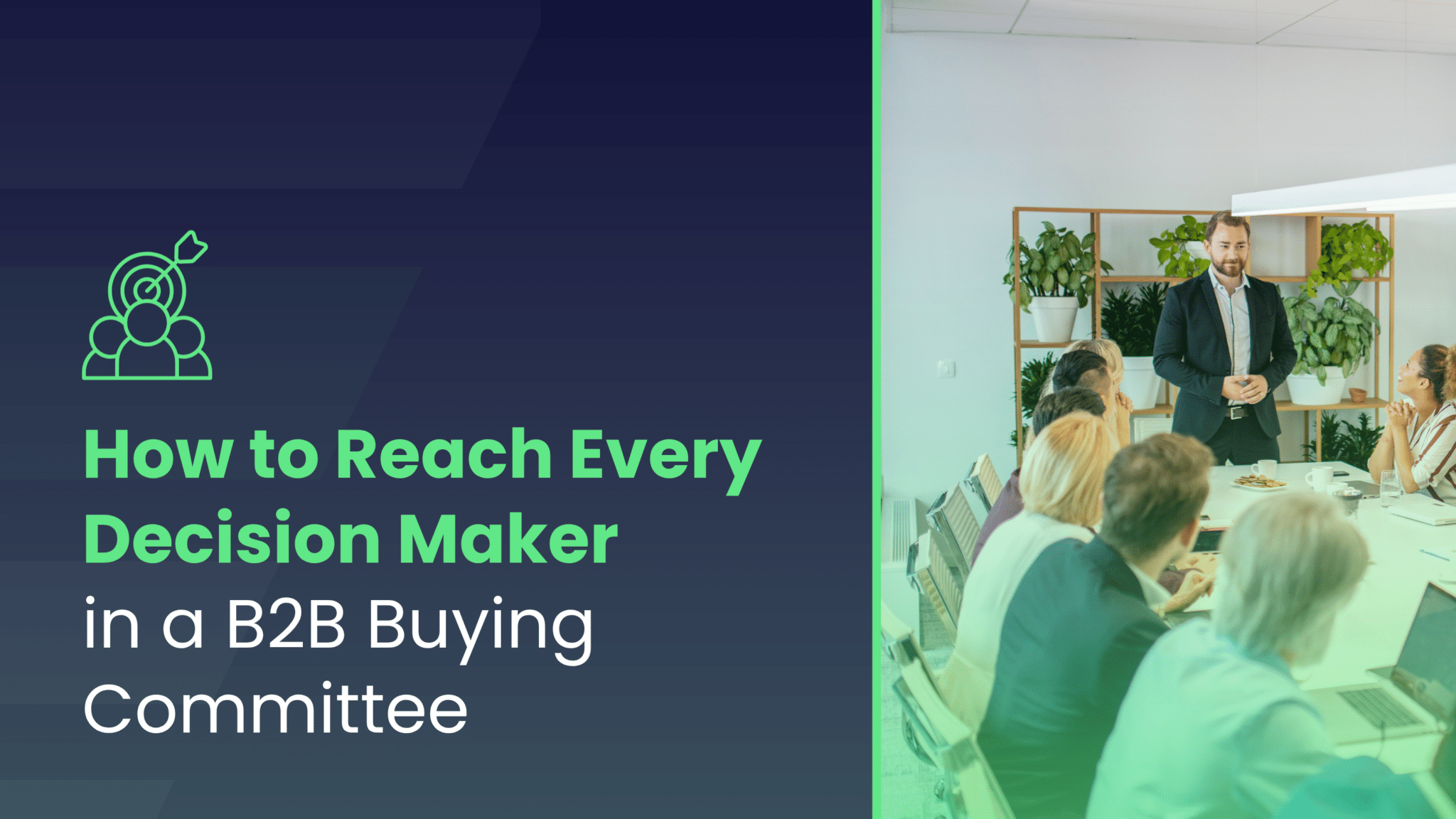
You Are Not Selling to a Person. You Are Selling to a Committee.
This is the shift most companies have not made. Their marketing still assumes one buyer, one journey, one form fill.
Gartner’s research on B2B buying puts the typical buying group for a complex solution at six to ten decision makers, and each one turns up having independently gathered four or five pieces of information. That is not one journey. That is six to ten separate journeys, running in parallel, mostly without you.
Worse, Gartner found buyers spend roughly two-thirds of the buying journey gathering, processing and de-conflicting information, much of it with no supplier involved at all.
Read that word again: de-conflicting. The committee is arguing with itself. Six people found different information and now have to reconcile it in a room you are not invited to.
If you have only ever spoken to one of those six people, you are not in that argument. You are a rumour.
Map the Committee by Role, Not by Job Title
Job titles lie. The same title carries different power at different companies. Instead, reach decision makers by role. Roles are stable.
Every meaningful B2B purchase has five roles. Sometimes one person holds two. Rarely does one person hold all five.
| The role | What they actually decide | What kills the deal if you ignore them |
| The end user | Whether it solves a real daily problem | They shrug. Nobody champions it. |
| The economic approver | Whether the money is justified | “Not this financial year.” |
| The implementation owner | Whether the business can absorb the change | “We do not have capacity right now.” |
| The risk gatekeeper | Whether it is safe (IT, legal, compliance, procurement) | One unanswered security question stalls everything. |
| The incumbent defender | Whether replacing the current supplier admits a mistake | Silent resistance you will never hear about. |
That last row is the one almost nobody plans for. Somebody at that company chose the provider you are trying to replace. Their judgement is on trial. They will not say so. They will just find reasons.
Same Claim, Different Fear
Here is where most companies get it wrong in the opposite direction. They hear “personalise for each stakeholder” and write five unrelated messages. Now the committee has five conflicting stories about you, and their de-conflicting problem got worse.
The rule is simpler than that: one claim, five fears.
Pick the single outcome your solution delivers. Anchor every message to it. Then change only what you address underneath.
| Who you are talking to | What they are quietly afraid of | What to put in front of them |
| End user | “This makes my day harder.” | A demo of the daily task, not the feature list |
| Economic approver | “I will have to defend this spend.” | The payback maths on one page |
| Implementation owner | “This lands on my team.” | A realistic timeline and who does the work |
| Risk gatekeeper | “This is my neck if it fails.” | Security, compliance and support answers, upfront |
| Incumbent defender | “This makes me look wrong.” | Framing around what changed in the market, not what they got wrong |
None of these are about your product. They are about consequences for a specific person.
How to Reach Decision Makers Who Never Fill In a Form
Research comes first, but recognise what research is. A contact list is not a strategy.
- Build the account list, then map the roles. Tools like Apollo or LinkedIn Sales Navigator will give you the names. Your job is to assign each name to one of the five roles above. If you cannot fill the economic approver row, you do not have a qualified opportunity yet.
- Advertise to the company, not the contact. Company-level targeting on LinkedIn lets you put the same message in front of every stakeholder at a named account. It means your champion is not carrying you alone.
- Arm the champion with something forwardable. Give them a one-page business case they can send internally without you in the room. Their name on the covering note, your numbers underneath. If your best asset is a demo booking link, you have given your champion nothing to fight with.
- Sequence by role, not by seniority. Reaching the CEO first feels efficient. The CEO simply delegates evaluation to the exact people you skipped.
The Blind Spot: The Meeting You Are Not In
Here is what separates the businesses winning group decisions from the ones losing them quietly.
Average companies are trying to win the meeting they attend. Top competitors have accepted they will never attend the meeting that matters, the one where all the decision makers are, so they optimise for that one instead.
Everything they produce is built to survive being forwarded. Their case studies work without narration. Their pricing is understandable without a rep explaining it. Their security documentation is public, because they know the risk gatekeeper will go looking for it at 4pm on a Thursday.
Ask an uncomfortable question. If your champion forwarded your last email to their CFO with no explanation attached, would it survive?
For most businesses, the honest answer is no. That is the gap.
Stop Counting Leads. Start Counting Coverage.
This is where the measurement problem bites. Six people influenced the deal. One filled in a form. Judge that campaign on lead volume and you will kill the campaign that was actually working.
It is the same trap as reporting on vanity metrics instead of revenue, applied to a group decision rather than a single buyer.
The metric worth tracking is Committee Coverage: the percentage of your target accounts where three or more distinct people have engaged with you.
- One contact engaged: fragile. This deal depends entirely on one person not changing jobs.
- Two contacts engaged: better, but usually still one function.
- Three or more, across different roles: this is where deals start closing on schedule.
Run that number monthly against your open pipeline. It will tell you which deals are real long before your forecast does.
The Bottom Line
You are not trying to convince a buyer. You are trying to help a group of people who disagree with each other reach an agreement.
To efficiently reach decision makers in a B2B buying committee start by mapping the five roles. Send one claim addressed to five different fears. Give your champion something they can forward. Then measure coverage instead of volume.
Your competitors are still buying clicks for a single job title. That is your opening.