
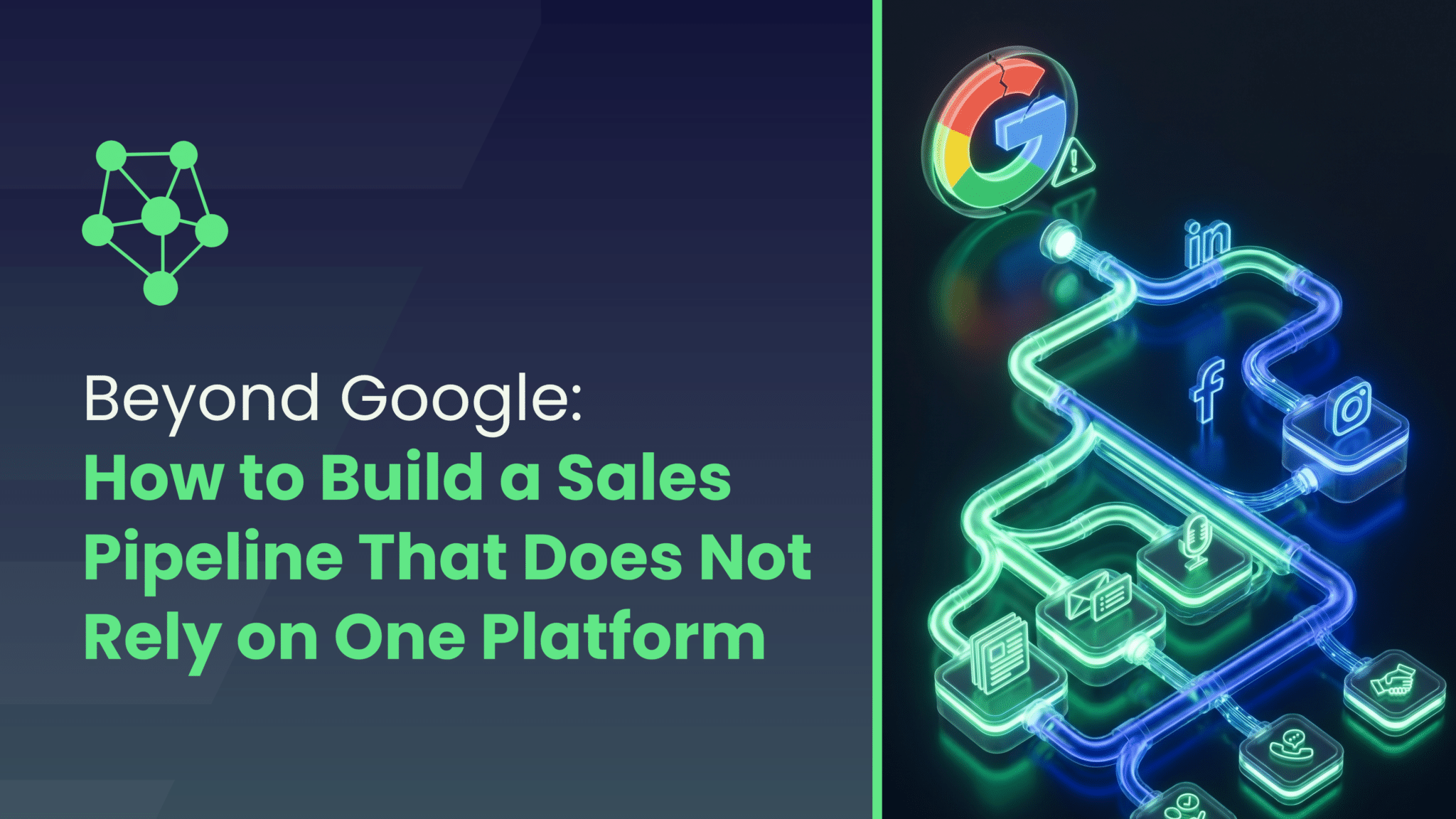
If your entire B2B sales engine relies on Google, you don’t own a marketing strategy. You own a temporary lease on an algorithm.
For years, B2B leaders treated search traffic like a guaranteed utility: flip a switch, pay the bill, and the leads flow. But the utility is changing the rules. Between AI-driven search results and constant algorithm updates, relying on a single platform isn’t just risky, it is a single point of failure that can stop your growth overnight.
Resilience isn’t about abandoning Google. It’s about making sure you have options.
1. The Search Monoculture is a Business Risk
In finance, putting 100% of your money into one stock is called negligence. In marketing, we often call it “the plan.”
Search intent has limits. It changes with the seasons, global shifts, and the rise of AI tools that answer questions before a user ever clicks your link. Even if buyer behaviour stays steady, your competitors won’t. New players can outspend you on ads or take your rankings in a single afternoon.
The Pragmatic Truth: Spreading your risk is no longer a luxury, it is a survival tactic for any disciplined leader.
2. Mind the Intent Gap (Search vs. Social)
The biggest mistake I see? Treating LinkedIn and Meta like Google.
On Google, people are hunting. They have high intent, you just need to be the best answer. On LinkedIn or Meta, you are interrupting. You are tapping into professional signals, not specific searches.
- Google Strategy: “Buy this solution now.”
- Social Strategy: “Here is an idea that makes you better at your job.”
If you use “Buy Now” messaging in a social feed, you will likely fail. You must bridge the gap by offering value that earns you trust before the buyer even realises they have a problem to search for.
| Feature | Google (Search) | LinkedIn & Meta (Social) |
| User Mindset | Actively looking for a solution | Consuming content and networking |
| Targeting Basis | Keywords and explicit intent | Professional signals and behaviours |
| Offer Type | Direct solution or service demo | Educational insight or industry “hook” |
| Sales Cycle | Usually shorter (needs-based) | Usually longer (awareness-based) |
| Primary Goal | Capture existing demand | Generate and capture future demand |
3. Mine the Gold in Your CRM
Before you pay to reach new audiences on social media, look at what you already own. Your email list and CRM data are the best opportunities you have.
Most businesses sit on “cold” lists of old prospects and past clients. These people already know your brand. A simple, helpful email campaign can bring these leads back for a fraction of the cost of a new Google click.
Pragmatic Rule: If Google disappeared tomorrow, your email list is the only thing that would still be working for you. Treat it like the revenue engine it is.
4. The Attribution Blind Spot
When you use more than one platform, the path to a sale gets messy. A prospect might see your LinkedIn post, ignore it, search for you on Google three days later, and finally sign up through an email.
If you only look at the “last click,” you will accidentally kill your most effective ways of getting noticed.
- Watch for the “Lift”: Look for increases in people searching for your brand name when social campaigns are live.
- Focus on the Big Picture: Measure the cost to get a customer across your entire marketing plan, not just one channel.
- Ignore the Noise: Low click rates on social do not matter if the quality of the leads you eventually get is higher.
5. Play “Surround Sound”
Modern B2B buyers need to see you 6 to 10 times before they trust you. If you only show up when they type a keyword, you have missed 90% of the journey.
Your best competitors are already building authority in the feed, the inbox, and industry newsletters. By the time that prospect finally gets to Google, they aren’t searching for a “general solution.” They are searching for your company by name.
The 90/10 Rule: How to Start Without Risk
Do not blow up what is working. Evolution is better than a total reset. Keep 90% of your budget where it is currently working, but set aside a 10% “Safety Fund” to test new areas.
The 90-Day Plan:
- Pick a Specific Target: Choose one industry or job title on LinkedIn. Do not try to reach everyone at once.
- Offer Something Useful: Create a simple guide or a checklist. Solve a problem, do not just sell a product.
- Run the 90-Day Test: Spend that 10% budget and leave it alone for three months. These systems need time to learn, being impatient will ruin your data.
- Check the Quality: Look at how many of these people eventually turn into real sales opportunities through other channels.
The Bottom Line
The days of “set it and forget it” Google marketing are over. To build a stable business, you must be where your customers are, no matter the platform. Stop being at the mercy of an algorithm and start taking control of your own market.
Self Diagnosis: Your Pipeline Resilience
Are you building a stable revenue engine, or are you just renting an audience from a single algorithm? Use these five questions to determine if your sales pipeline is resilient or highly vulnerable.
The Questions:
-
- 🗹
Have you diversified your marketing budget beyond a single platform (like Google) to protect your pipeline from sudden algorithm updates?
- 🗹
Do you adjust your messaging based on platform intent, offering educational value on social media rather than just pushing “Buy Now” ads to cold audiences?
- 🗹
Are you actively mining your existing CRM and email list to re-engage “cold” prospects, rather than solely paying for net-new traffic?
- 🗹
Do you track multi-channel attribution (the “Surround Sound” effect) to ensure you aren’t accidentally killing awareness campaigns based on flawed “last-click” reporting?
- 🗹
Do you actively dedicate a specific percentage of your budget (e.g., a 10% “Safety Fund”) to test and validate new platforms every 90 days?
- 🗹
The Verdict:
- 4–5 “Yes” answers: You have a Resilient Pipeline. You understand how to generate demand across multiple touchpoints, ensuring your business growth is insulated against platform volatility.
- 0–3 “Yes” answers: You are running a Search Monoculture. Your entire revenue engine is a single point of failure. If one algorithm changes its rules tomorrow, your pipeline will completely dry up.