
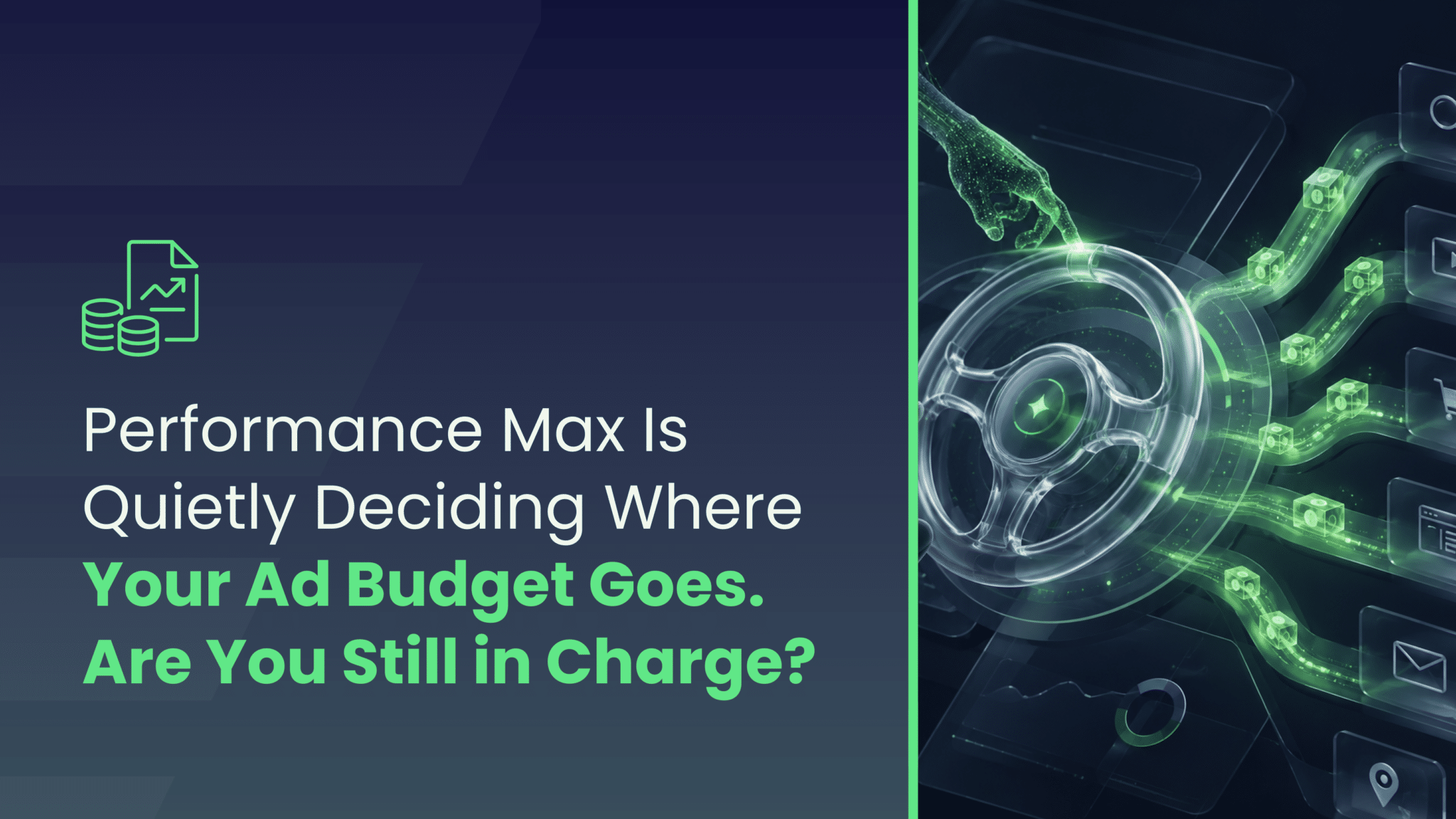
Performance Max decides which placements you show up in, which audiences see your ads, and how much you pay for each one. That is a lot of ground to hand over to a system you cannot fully see inside. So the real question is not whether this tool works. It is whether you are still steering where your budget goes, or just watching it move.
The honest answer is yes, but only if you know which levers are still yours.
What Performance Max Actually Decides
Performance Max is an automated campaign type inside Google Ads. Once you set a budget and a goal, the algorithm decides:
- Which placements get your ad (Search, Shopping, YouTube, Display, Discover, Gmail, and Maps)
- Which audiences see it
- How much to bid in each auction
You no longer pick these manually. That is the trade-off. In exchange for less manual work, you get less line-of-sight into why the system made the choices it made.
The Real Issue: Cheap Placements, Not Valuable Ones
Here is what I see most often in accounts I manage. The algorithm is built to hit its target efficiently. Efficient does not always mean valuable.
Left alone, Performance Max tends to chase the cheapest path to a conversion. That often means retargeting people who already know your brand, rather than finding new customers. It looks great on a dashboard: strong ROAS, low cost per lead. But if most of those “conversions” would have happened anyway, you are not growing. You are just paying to take credit for sales you already had.
This lines up with what industry analysis has found: Performance Max defaults to retargeting and existing customers because they are the easiest conversions to claim credit for. Retargeting an existing customer is an easy win. Finding a genuinely new buyer takes more work and more spend. Without direction from you, the system defaults to the easy win every time.
What You Still Control
This is the part most business owners get wrong. They assume automation means they have handed over the keys entirely. They have not. You still control the inputs that shape every decision the algorithm makes.
| What You Set | What It Controls |
| Daily or monthly budget | The ceiling on total spend |
| Target CPA or ROAS | How aggressively the system bids |
| First-party data feeds | Who the system learns to target |
| Exclusion lists | Which audiences and placements are blocked |
| Creative assets (all formats) | What gets served, how it performs, and whether it looks like your brand |
You are not a passenger. You are the one setting the rules the system has to work inside. The mistake is treating Performance Max as “set and forget.” It is not. It needs direction, and that direction has to be maintained.
Four Things to Do This Week
If you want to stop the algorithm from defaulting to the cheapest option instead of the best one, focus on these four levers.
- Feed it real, first-party data.
The more accurate data you give the system about who actually buys from you and what they are worth, the better it gets at finding similar people. Weak or generic data pushes the algorithm back toward guessing, and guessing usually means chasing cheap, low-value traffic. - Use exclusion lists properly.
You can also exclude existing customer lists and low-quality placements from acquisition campaigns, so the system stops taking credit for sales that would have happened anyway. This is one of the most underused controls available, and it takes minutes to set up. - Set clear audience signals, not vague ones.
Vague signals give the algorithm too much room to default to easy wins. Specific, well-built audience signals (based on real customer data, not guesses) narrow that room and push the system toward the type of customer you actually want. - Supply full creative assets in every format.
If you leave gaps, Performance Max fills them by combining whatever assets you did provide. The result is often generic, off-brand, or visually rough, since the system is optimizing for performance, not brand fit. Providing images, videos, headlines, and descriptions in every required format keeps you in control of what actually gets shown.
None of this requires you to take manual control back. It requires you to be deliberate about what you feed the system.
Why This Matters More Than It Looks
Here is the part worth sitting with. Every business running Performance Max right now has access to the same controls. Budget, exclusions, data feeds, audience signals. The businesses pulling ahead are not the ones with bigger budgets. They are the ones actually using these controls with intent, every week, instead of leaving the account on autopilot.
The businesses falling behind are the ones assuming automation means “nothing to manage.” They set a target once, walk away, and wonder six months later why their cost per lead climbed and their new customer numbers stalled. By the time they notice, a competitor has spent those same months feeding the algorithm better data and tightening exclusions, and that gap compounds every month it goes unaddressed.
The Bottom Line
You are still in charge of your ad budget. Google is not choosing how much you spend. What it is choosing is where that spend goes, and if you leave that decision entirely to the algorithm, it will default to the easiest, cheapest path rather than the most valuable one.
The fix is not fighting the automation. It is feeding it better instructions: real customer data, proper exclusions, and clear signals about who you actually want to reach. Do that consistently, and you stay the one calling the shots, even inside a fully automated system.