
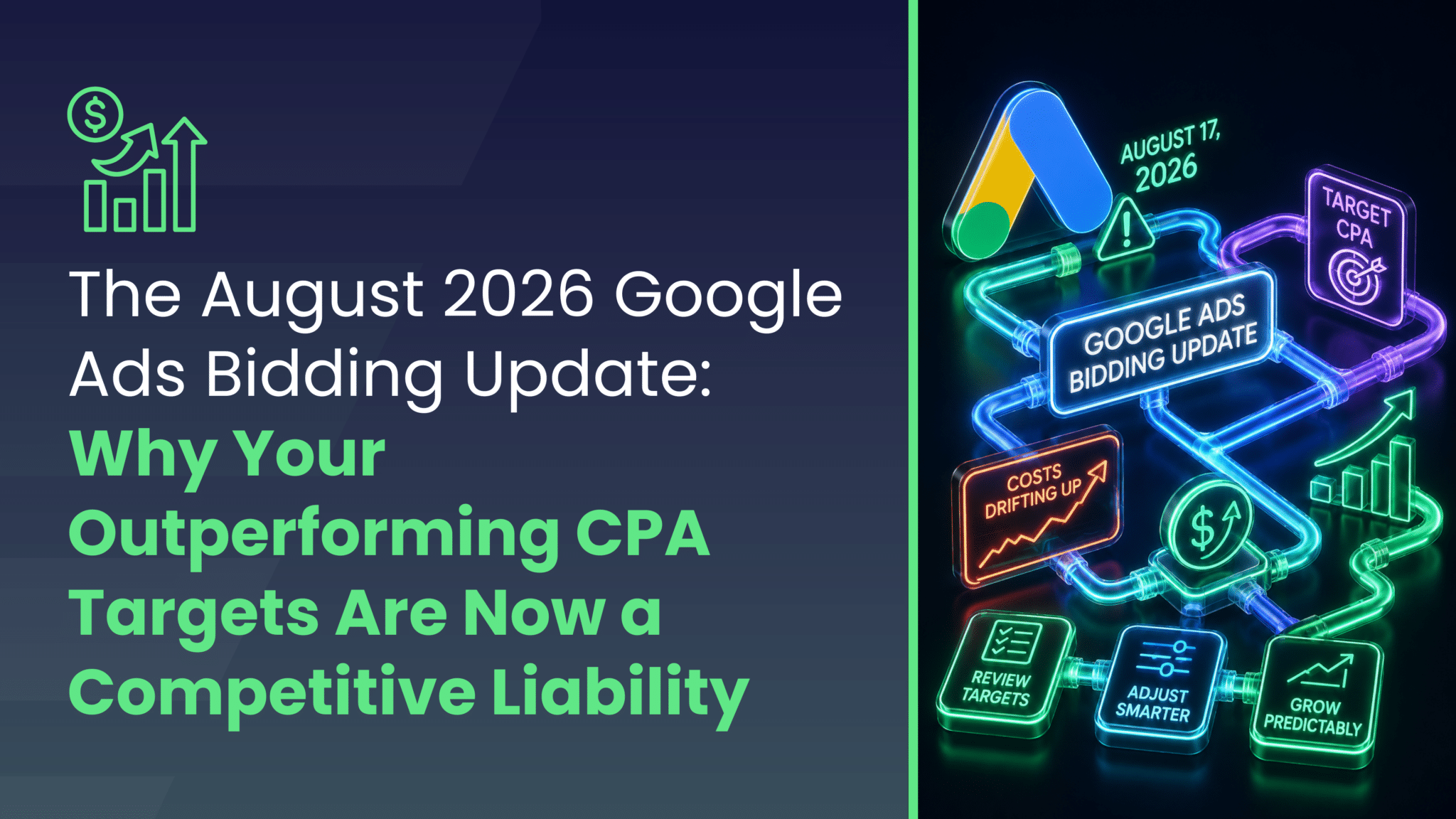
After the upcoming August 2026 Google Ads bidding update, campaigns that are limited by budget will automatically become more expensive if your actual costs are lower than your set targets. Google’s algorithm will push your costs up to match your stated targets, raising your customer acquisition costs unless you manually lower those targets before the deadline.
For a long time, business owners and marketing teams had a comfortable routine. They believed that setting a high, safe target inside an automated ad campaign was a smart, hands-off tactic. The general idea was simple: as long as you put a strict limit on your daily budget, Google would naturally keep your costs low and run your ads efficiently.
That old trick is going away completely on August 17, 2026.
This upcoming change is a major shift in how Google Ads bidding uses machine learning for campaigns with capped budgets. If you do not prepare for this adjustment right now, your marketing performance will drop, and you will end up wasting money that hurts your bottom line.
The Old Way: How Google Ads Bidding Used to Work
To understand why this upcoming Google Ads update is a big risk for your business, you need to understand how ad bidding has worked for years.
Marketing teams often set intentionally loose or high numbers for their Target CPA (Cost Per Acquisition) or Target ROAS (Return on Ad Spend). They did this on campaigns that had a “Limited by budget” warning. They knew that Google’s smart bidding system would still spend their money wisely because the daily budget cap kept the system under control.
Under the old rules, your daily budget was the real safety brake. The high target simply gave Google more room to enter different auctions, test what worked, and reach more people.
Because of this, the system often overperformed. It brought in customers for much less money than the maximum target typed into the dashboard. For example, a business might tell Google they are willing to pay an $80 Target CPA, but the campaign would actually get customers for $45. The strict daily budget naturally stopped the system from bidding too aggressively or wasting cash.
The August 2026 Google Ads Bidding Update: Why Your Costs Will Drift Upward
Starting August 17, 2026, Google Ads bidding is changing. The system is getting an upgrade to make sure your ads perform exactly like the targets you set.
If your campaign has a limited budget and usually beats the target you set, you are going to see sudden drops in performance if you leave things alone. The algorithm will no longer look for the cheapest possible loopholes under your budget cap. Instead, it will deliberately push your costs up until they match the higher target you typed into the system.
What Happens to Your Ad Costs After the Update
| Your Campaign Type | The Old Way (Before August 2026) | The New Way (After August 17, 2026) | The Direct Impact on Your Wallet |
| Outperforming Campaigns
(Your Target: $80 / Real Cost: $45) |
Google keeps your real cost low ($45) because your daily budget limits spend. | Google automatically raises your bids to meet your official $80 target. | You pay almost double for the exact same number of leads. |
| Correctly Balanced Campaigns
(Your Target: $45 / Real Cost: $45) |
Google matches your target and budget smoothly. | Google keeps your performance steady and predictable. | Your results stay stable and you can safely grow. |
| Multi-Channel Campaigns
(Performance Max & Demand Gen) |
Your ad traffic stays steady across different websites and apps. | Google moves your budget around automatically to hit the target. | Sudden, unpredictable changes in where your leads come from. |
The Real Danger of Doing Nothing
If a business leader ignores the automatic warnings popping up in their Google Ads account, the result is very clear: your real cost to get a customer will climb. A smooth, affordable stream of leads will quickly turn into an expensive problem.
This is not just a minor detail. Wasted ad spend is already a massive issue for businesses. A recent industry study showed that the average business wastes about 36% of its ad budget on campaigns that generate plenty of clicks but fail to create a real revenue pipeline. If you leave your targets mismatched when this new update hits, your amount of wasted cash will go up significantly.
The real advantage will go to business owners who use this upcoming deadline to review their actual profit margins. Your competitors will probably treat this update like a simple box to check. They will click the automatic recommendation buttons without checking their real financial math. Because of that, their campaigns will drift back to old, arbitrary cost numbers instead of numbers that match their true business goals.
Your Action Plan: What to Tell Your Team
To protect your profits and stop this automatic cost inflation after the Google Ads Bidding Update, you need to take action ahead of time. Do not let your marketing team wait until the last minute. You should start working on this now, ideally two to three weeks before the August 17 deadline.
Sit down with your marketing team and give them this specific checklist:
- Find Capped Budgets: Look through the account and make a list of every campaign that says “Limited by budget” and uses Target CPA or Target ROAS.
- Open the Adjustment Tool: Google launched a new tool called the Bid Target Adjustment Tool on July 6, 2026. Have your team open it to see your past performance data.
- Lower Targets Slowly: Reduce your bidding targets gradually in small steps. Do not drop them all at once. Making a huge, sudden change will confuse Google’s smart bidding system and can freeze your lead flow. Small, incremental changes let the system learn the new rules smoothly.
- Track the Changes: Ask your team to give you a simple report showing the before and after numbers for every single campaign adjustment.
- Review Your Real Math: Look for any campaigns where your recent costs do not match what you actually want to pay. This upcoming update is the perfect excuse to reset your targets based on your actual profit margins rather than just acting defensively.
The Good News: Better Growth and Forecasting
Even though losing this old bidding trick requires extra work right now, the long-term results of the Google Ads bidding update are actually a good thing for businesses that want to grow.
Once the new system is active, budget increases will behave predictably. In the past, if you added money to a budget-limited campaign that was outperforming its target, the system would often break down. Your costs would spike wildly because the algorithm did not know how to handle the sudden influx of cash.
Under the new model, you can build reliable business forecasts. When you decide to invest more money into your ads, the system will scale up smoothly while keeping your costs close to your chosen target.
However, you have to accept one major tradeoff: stable does not mean cheaper. The real cost to get a customer in this new environment will likely be higher than the artificially low prices your business enjoyed under the old rules. You must build your future growth plans around these honest numbers rather than assuming the old, cheap results will last forever.
Taking Control of Your Marketing
Automated ad systems are only as smart as the rules you give them. Google is giving you the tools to protect your business, but the platform will not fix your account for you.
Doing nothing after this Google Ads bidding update means you are letting an automated system decide your profitability. By enforcing a strict, step-by-step review of your targets over the next few weeks, you can turn this upcoming risk into a reliable, predictable system for growth while your slower competitors pay the price.
Self Diagnosis: Your Target Integrity
Are you prepared for algorithmic changes, or are you accidentally paying Google to inflate your acquisition costs? Use these five questions to determine if your ad targets are acting as a strategic lever or a competitive liability.
5 Quick Questions:
-
- 🗹
Has your marketing team audited every active Google Ads campaign to identify outperforming targets before the August 2026 algorithm update takes effect?
- 🗹
Do you currently rely on “loose” or artificially high Target CPAs/ROAS combined with a strict daily budget cap to try and outsmart the algorithm?
- 🗹
Have you systematically lowered your bidding targets to match your actual historical performance, preventing the system from automatically pushing your costs up?
- 🗹Do you evaluate your bidding strategy based on actual profit margins and closed-won revenue, rather than treating arbitrary dashboard targets as a “set and forget” tactic?
- 🗹Does your leadership team proactively adjust your digital infrastructure in response to platform updates, rather than waiting for performance to drop before taking action?
- 🗹
The Verdict:
- 4–5 “Yes” answers: You have Target Integrity. You understand that algorithmic bidding requires precise inputs. By proactively adjusting your targets to match real performance, you protect your budget from artificial inflation and ensure your campaigns remain highly efficient in the new landscape.
- 0–3 “Yes” answers: You are exposed to the Inflation Trap. Your historical success is now a liability. Because you are relying on outdated bidding tactics and leaving artificially high targets in the system, Google’s algorithm will automatically push your acquisition costs upward, effectively forcing you to pay significantly more for the exact same number of leads.