

The difference between a cheap click and a real sales meeting is the intent behind the action. While a cheap click represents a user showing passing curiosity, a sales meeting represents a verified prospect with a specific problem seeking a solution. Shifting your focus ensures your marketing budget drives revenue rather than just website traffic.
The Traffic Shield: Why Your Marketing Reports Are Lying to You
For many business leaders, the monthly marketing report is a source of quiet frustration. The charts show “Clicks” are up and “Cost Per Click” (CPC) is down. On paper, the account looks efficient. However, the sales team is still complaining about “ghost leads” and the calendar remains empty. This is the Traffic Shield in action.
If they can send a massive volume of people to your website for a low cost, they can claim their job is successfully completed. When those visitors do not convert into a single dollar of revenue, the blame is often shifted elsewhere. They point to the product offering, the pricing structure, or the perceived inability of the sales team to close.
The gap between traffic and value is wide. Research from HubSpot shows that only 34% of B2B marketers believe their ads actually find high-quality leads. Yet, businesses continue to pour money into these strategies. This creates a “Volume vs. Value” trap that quietly drains marketing budgets.
Chasing cheap clicks also wastes your payroll. You are essentially paying your top sales talent to act as “digital janitors.” Instead of closing deals, they spend their day cleaning up junk leads and talking to people who have no intention of converting. Using your most expensive employees to sift through low-intent noise is a disaster for your bottom line.
Statistic Source: HubSpot: The State of Marketing Report
The Algorithm Trap: Training Google to Find Your Failures
One of the most dangerous blind spots in modern B2B strategy is a misunderstanding of how Google Ads AI actually works. The algorithm is a literal machine: it gives you exactly what you reward it for.
If you tell Google that your goal is “Clicks” or “Traffic,” the AI will hunt for the cheapest possible users who are likely to click an ad. These are often “window shoppers” or researchers with zero intention of signing a contract. By rewarding the platform for high traffic volume, you are effectively training the machine to ignore your real customers in favor of high-volume, low-intent noise.
This creates a feedback loop of failure:
- The Reward: You pay for a cheap click that leads nowhere.
- The Signal: Google sees the click and interprets it as a success.
- The Result: The AI goes out and finds more people who exhibit that same “click-only” behavior.
- The Reality: Your CRM fills with digital litter while your competitors, who optimize for meetings, win the high-value buyers.
The “Conversion” Lie: Moving Beyond PDF Downloads
The “original sin” of most Google Ads accounts is how they define a “conversion.” Most businesses treat a PDF download or a newsletter signup as a win. In a boardroom context, these are vanity metrics. Does it really matter if you generate a mountain of whitepaper downloads if none of those people ever speak to a sales representative?
A real conversion should be defined by the completion of a sales milestone. We should be optimizing towards people who have actually moved through the sales process. The table below illustrates the stark difference between a traditional “Traffic-First” approach and a “Meeting-First” strategy.
Traffic-First vs. Meeting-First Strategy
| Feature | Cheap Click Strategy (Traffic-First) | Sales Meeting Strategy (Meeting-First) |
| Primary Metric | Cost Per Click (CPC) | Cost Per Meeting / Cost Per Deal |
| AI Goal | Maximize Traffic Volume | Maximize Pipeline Revenue |
| User Intent | Curiosity and Research | Problem-Solving and Intent to Buy |
| Sales Impact | High Volume of Unqualified Leads | Low Volume of High-Value Meetings |
| Executive Value | Marketing “Busywork” | Predictable Revenue Growth |
| Data Loop | Browser-based tracking | CRM-integrated feedback |
The Technical Blind Spot: The Missing Link to Your CRM
The reason most companies stay stuck in the cycle of buying cheap clicks is a technical disconnect. Data privacy regulations and siloed systems often prevent marketing teams from seeing which specific keywords actually resulted in a signed contract. Without this visibility, the marketing team is forced to guess which parts of their strategy are working.
Most companies do not (or cannot) feed their CRM data back into their advertising platforms. This is a catastrophic strategic error. Without this integration, your marketing team is flying blind. They are optimizing for the start of the journey rather than the end of it.
To break this cycle, you must fully integrate your CRM with your Google Ads account. This allows you to tell the algorithm to stop finding people who merely download documents. Instead, the machine is told to find more people who match the profile of a customer who has already paid for the service. This transition is technically demanding and requires a shift in how data is handled, but it is the only way to build a competitive advantage that others cannot easily replicate.
The CFO’s Paradox: Why a Higher CPL is a Massive Win
When you shift your focus from clicks to meetings, your “Cost Per Lead” (CPL) will almost certainly appear to skyrocket. To a CEO or CFO looking at a basic spreadsheet, this can look like a failure. However, this is the CFO’s Paradox: paying a much higher price for a guaranteed sales meeting with a qualified decision-maker is infinitely more profitable than paying a small amount for a lead that never picks up the phone.
The conversation in the boardroom needs to change. Leadership must stop asking how the team can get cheaper leads and start asking what the actual cost is per completed deal. When you optimize for the end of the funnel, you are effectively buying back the time of your sales team.
The goal of marketing is not to keep the sales team busy. It is to keep them profitable. By shifting the success metric, you align the incentives of the marketing department with the revenue goals of the entire organization.
Strategic Diagnosis: Are You Buying Traffic or Revenue?
If you are unsure whether your current Google Ads strategy is building an asset or just creating noise, ask your team these four questions:
- The Intent Check: If we removed all “content downloads” from our conversion tracking, would our Google Ads account still look successful?
- The AI Signal: Are we telling Google who actually bought our product, or are we just telling them who filled out a form?
- The Sales Reality: Does our sales team spend more time disqualified “leads” from Google than they do advancing high-value sales opportunities?
- The Metric Shift: If we cut our traffic in half but doubled our “Sales-Accepted Pipeline,” would our marketing team view that as a win or a loss?
The Path Forward
Stop rewarding curiosity and start rewarding commitment. The transition from paying for cheap clicks to paying for real sales meetings requires a fundamental shift in both technology and mindset. It requires the courage to watch vanity metrics drop in exchange for watching revenue rise.
In the modern B2B landscape, the companies that win are not the ones with the most traffic. They are the ones with the most intelligent data loops. It is time to stop counting the clicks and start counting the dollars.
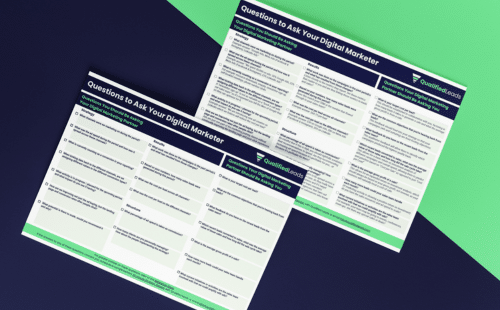
Self Diagnosis: Your Traffic vs. Pipeline Strategy
Are you buying predictable revenue, or are you just buying website traffic? Use these five questions to determine if your marketing strategy is feeding your sales team or starving them.
5 Quick Questions:
-
- 🗹
Are you tracking “Cost Per Meeting” or “Cost Per Deal” as your primary marketing KPIs, rather than just celebrating “Cost Per Click” or overall lead volume? - 🗹
Is your CRM fully integrated with your ad platforms, actively feeding “Closed-Won” financial data back to the algorithm to train it? - 🗹
If you removed all low-friction conversions (like PDF downloads and newsletter sign-ups) from your reporting, would your marketing ROI still remain profitable? - 🗹Does your sales team spend the vast majority of their time conducting high-value discovery calls, rather than disqualifying “ghost leads”?
- 🗹Does your leadership team understand the “CFO’s Paradox”—that paying a significantly higher Cost Per Lead (CPL) is a massive win if it guarantees a meeting with a qualified buyer?
- 🗹
The Verdict:
- 4–5 “Yes” answers: You are a Pipeline Architect. You are optimizing for revenue, not vanity metrics. Your ad algorithms are properly trained to find high-intent buyers, keeping your sales team highly profitable.
- 0–3 “Yes” answers: You are a Traffic Shield Victim. You are caught in the volume trap. You are paying for cheap clicks, training Google to find window-shoppers, and turning your expensive sales team into “digital janitors.”