
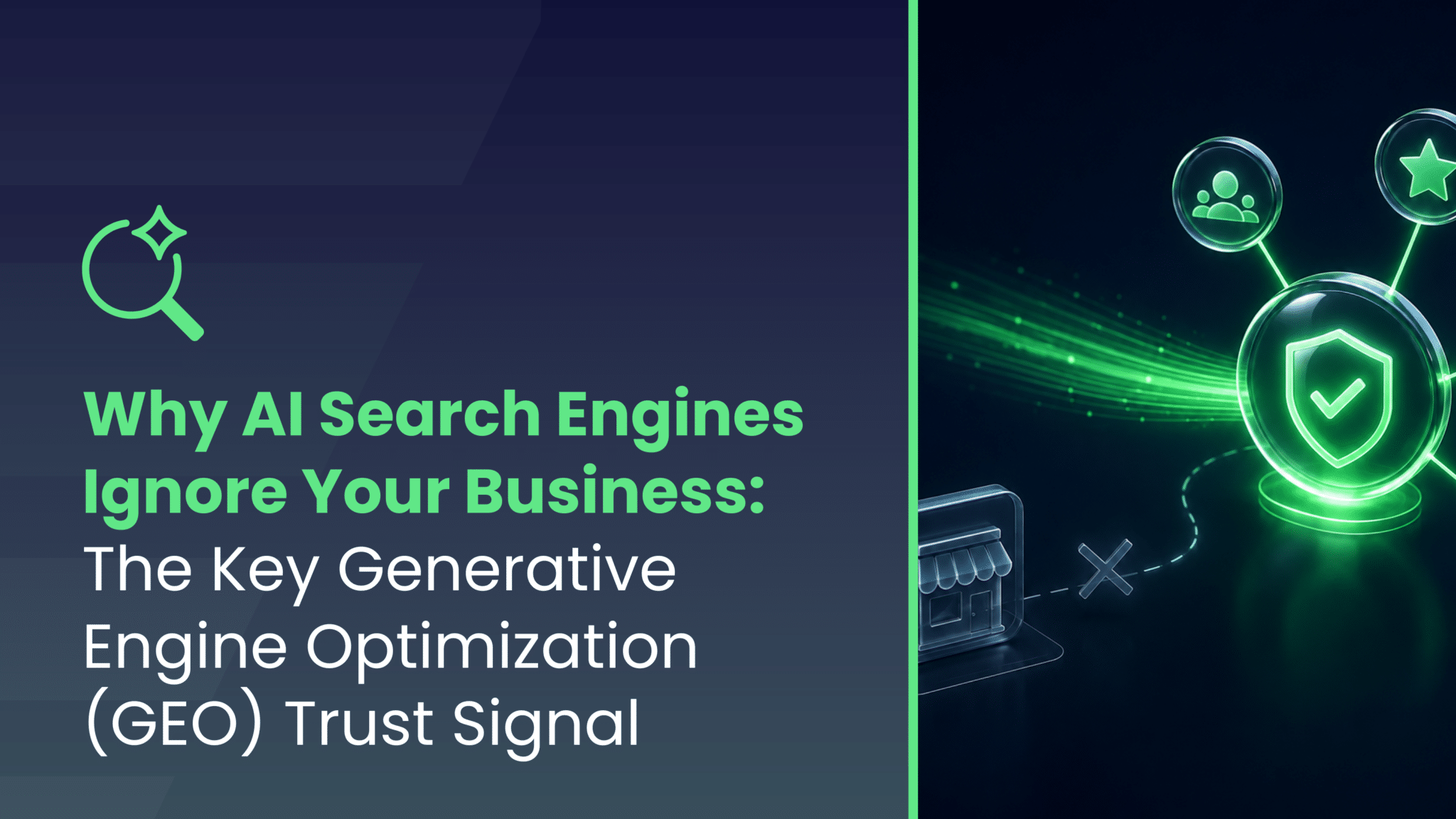
The key reason why AI search engines ignore your business is because they treat your website as unverified testimony. When platforms like ChatGPT, Perplexity, or Google AI Overviews deliver recommendations, they bypass self-proclaimed market leaders to cite brands validated by third-party data, active Knowledge Graphs, and independent consensus. This missing link is often the single most critical Generative Engine Optimization (GEO) trust signal keeping your brand invisible.
Winning AI visibility requires shifting from traditional SEO to Generative Engine Optimization (GEO) by building off-site trust signals, structuring extractable entity data, and providing original information gain.
Why AI Search Engines Ignore Your Homepage Claims
Most business leaders fall into a dangerous trap: assuming that declaring themselves “#1 in the industry” on their own homepage means AI engines will take their word for it. They will not.
Large Language Models (LLMs) do not evaluate self-published claims the way traditional search engines evaluate keyword-stuffed landing pages. To an AI model, your site is an unverified witness. If your bold marketing assertions are not backed by third-party coverage, cited in trade press, or validated across independent industry channels, AI treats your brand as a potential hallucination risk.
While companies celebrate their polished website messaging, AI engines quietly bypass their brands to cite competitors who offer external proof.
| Brand Signal Source | LLM Trust Evaluation | AI Search Outcome |
| Self-Proclaimed Claims
(Homepage copy, self-written ads) |
❌FAILS
Unverified testimony treated as a potential hallucination risk. |
Bypassed / Ignored |
| Third-Party Consensus
(Digital PR, verified reviews, schema) |
✅PASSES
Validated entity context supported by external data. |
Featured & Cited |
Traditional PR vs. Knowledge Graph Entity Building
Traditional “vanity PR”—paying for syndicated press releases that get blasted across low-tier news scrapers—is entirely useless in AI search. LLMs spot syndicated noise instantly and filter out low-value duplicate copy without giving it a second glance.
In Generative Engine Optimization (GEO), Digital PR is not about collecting links for vanity metrics. It is about Entity Building inside Knowledge Graphs.
| Traditional PR (Ignored by AI) | Entity Digital PR (Trusted by AI) |
| Blast syndicated press releases | Unsponsored editorial mentions |
| Keyword-stuffed anchor text links | Semantic Context & Entity Vectoring |
| Self-published promotional blogs | Crowdsourced consensus on G2/Reddit |
| Low-tier link farm placements | Clear JSON-LD sameAs connections |
What Makes a Brand Mention Trusted by AI?
- Unsponsored Editorial Coverage: Mentions embedded within authentic, non-sponsored editorial pieces on high-authority domains carry genuine credibility.
- Semantic Context (Entity Vectoring): AI evaluates the exact words surrounding your brand. If your company name repeatedly appears alongside terms like “enterprise compliance” or “logistics automation,” the LLM builds a permanent semantic connection between your brand and that specific domain expertise.
- Crowdsourced Consensus: Independent platforms such as Reddit, Quora, industry forums, and verified review sites (G2, Capterra, Trustpilot) are heavily weighted by LLMs because they represent real human sentiment rather than corporate spin.
The Expert Content Trap: Why Generic How-To Articles Fail
Publishing bloated, 1,500-word blog posts explaining basic industry concepts does nothing to build AI trust. It simply adds to digital noise.
LLMs already know basic “how-to” advice. They generated their foundational knowledge bases from millions of those exact articles. To force an AI engine to cite your brand, your content must offer genuine Information Gain.
To make your content “AI-proof,” implement a few core structural requirements:
- Answer-First Architecture: Deliver immediate, concise answers to core queries within the first 60 words of every major topic section.
- Proprietary Grounding Data: Publish unique metrics, proprietary industry benchmarks, and original research that the LLM cannot find anywhere else on the web.
- Structured FAQs: Format key landing pages into direct question-and-answer pairs wrapped in FAQPage JSON-LD schema for effortless Retrieval-Augmented Generation (RAG) extraction.
What Top Brands Do Under the Hood
Frustrated businesses focus 100% of their energy on their primary domain name. Market leaders, by contrast, engineer their entire digital footprint into a unified, machine-readable Knowledge Graph.
Winning brands do not just optimize a standard website. They systematically align their entity across the entire web.
The Blind Spots Competitors Are Capitalizing On
- Granular JSON-LD Schema Markup: Machine-readable code that maps relationships between your organization, products, executives, and publications.
- Third-Party Review Seeding: Actively managing and verifying product capabilities across independent rating networks.
- Un-Gated Comparison Frameworks: Publishing clean, transparent comparison tables that make it effortless for AI engines to parse, extract, and recommend their solutions over alternatives.
3 Non-Negotiable Trust Guardrails for AI Search Visibility
If your business is currently invisible in AI-generated answers, apply these three non-negotiable trust guardrails immediately to establish brand authority.
1. Technical Entity Alignment (Build the ID)
Deploy Organization JSON-LD Schema across your entire website. Utilize sameAs tags to explicitly connect your primary domain to your official LinkedIn, Crunchbase, Wikipedia, and review profiles. This gives AI crawlers an unambiguous signal that all these separate digital touchpoints represent one single, legitimate real-world entity.
2. Distributed Off-Site Consensus (Prove the Claims)
Standardize your product capabilities, service offerings, and brand positioning across third-party platforms. AI models cross-reference independent environments to validate your claims before risking a brand recommendation to a user.
3. Grounding & Extractable Architecture (Provide Citable Data)
Ensure your site architecture is built for extraction. Beyond structuring your primary landing pages into direct Q&A formats, place a clean llms.txt file at your root directory. While not a direct ranking cheat-code, it gives autonomous AI agents a clean, markdown-formatted roadmap of your brand’s core data.
Research published by Princeton University, Georgia Tech, Allen Institute for AI, and IIT Delhi, shows that implementing structured Generative Engine Optimization tactics, such as citing authoritative data and structuring verifiable sources, can boost a brand’s visibility and impression rate in AI-generated responses by up to 40%.
Frequently Asked Questions
What is the difference between SEO and AEO/GEO?
SEO focuses on ranking pages in traditional search engine results through keywords, backlinks, and technical site optimizations. AEO (Answer Engine Optimization) and GEO (Generative Engine Optimization) focus on positioning a brand as the authoritative answer extracted by AI models like ChatGPT, Claude, and Google AI Overviews using structured entity data, third-party validation, and information gain.
Does traditional link building still work for AI search?
No, traditional link building focused purely on domain authority metrics or mass directory submissions is ineffective for AI search. AI models focus on semantic entity relationships and contextual citations rather than sheer link volume. A single un-sponsored editorial mention on an industry-standard publication carries far more weight for LLM trust than dozens of low-quality guest blog backlinks.
How quickly can a brand appear in AI-generated answers?
Timeline depends on the retraining and real-time retrieval cycles of the specific AI engine. Platforms using live web retrieval (like Perplexity or Google AI Overviews) can start picking up structured schema changes, clean llms.txt files, and third-party entity mentions within weeks. Static model knowledge updates take longer, depending on training data refreshes.