
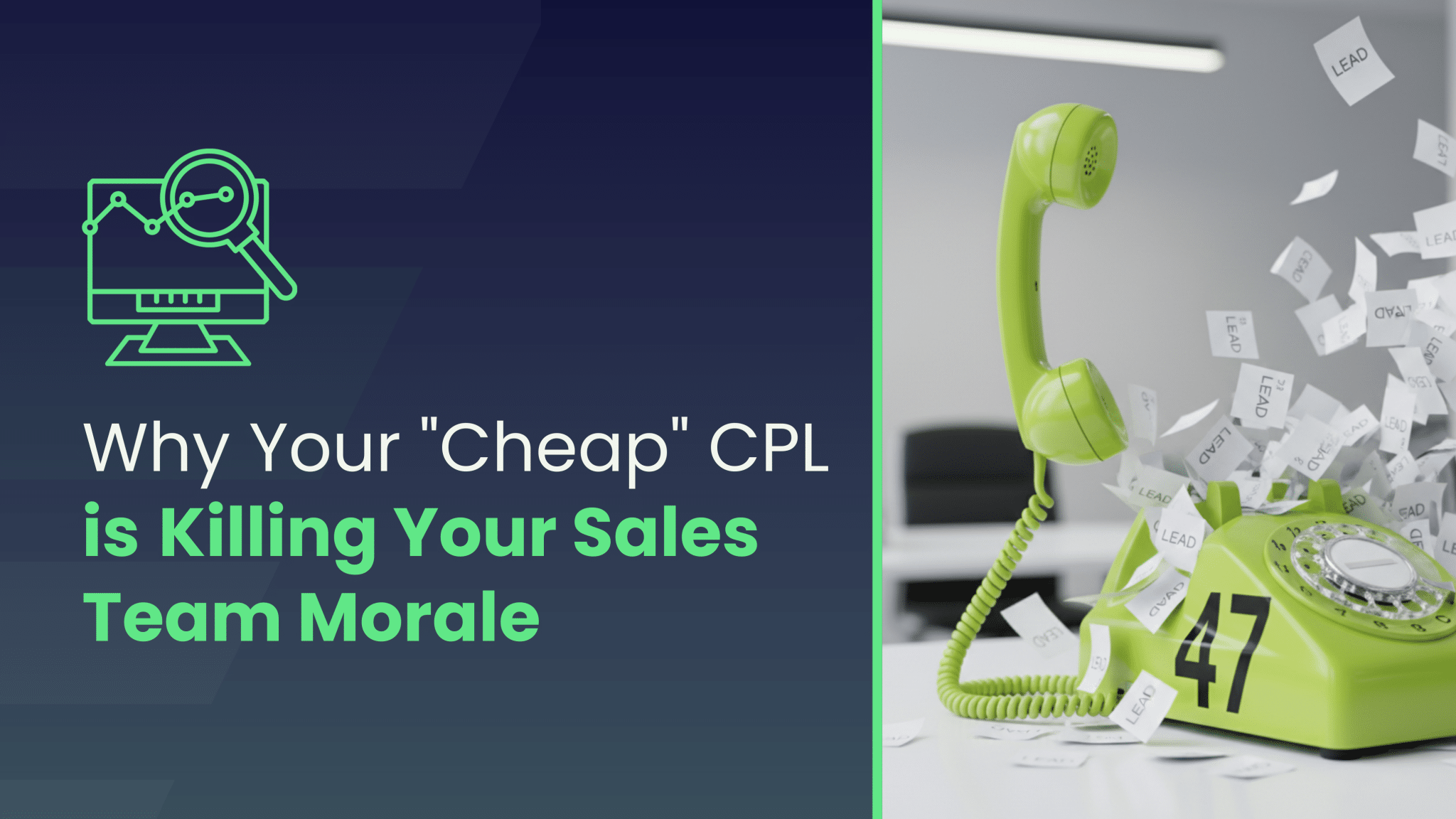
If your Marketing Agency focuses solely on lead volume and cheap cost per lead (CPL) without demonstrating concern for lead quality or pipeline progression, they are failing the business.
In many cases, a plummeting CPL is a leading indicator of a looming revenue crisis. While marketing departments often celebrate a high volume of inexpensive leads as a sign of efficiency, the reality on the sales floor is frequently much darker.
When a business optimizes for the lowest possible lead cost, they often unknowingly trade their sales team’s time and morale for a vanity metric that fails to convert into bankable deals.
High Lead Volume vs Lead Quality
High lead volume at a low cost is a convenient way to mask a lack of actual conversions. However, this “efficiency” comes with a hidden tax.
When the sales team is forced to sift through hundreds of low-intent leads, they encounter a psychological drain that is difficult to quantify but impossible to ignore.
A salesperson who spends their day chasing “cheap” leads quickly loses faith in the marketing engine.
An example of this is the “Non-Decision Maker” Observer: junior employees or interns tasked with “gathering options” who possess zero budgetary authority.
After weeks of nurturing what looked like a promising prospect, the salesperson discovers they have been pitching to a gatekeeper with no power to sign a contract.
This creates a culture of skepticism where even a genuinely high-quality lead might be treated with the same indifference as the previous fifty bad ones.
The Great Disconnect: KPI Misalignment
The tension between sales and marketing usually stems from a fundamental disconnect in how success is defined.
Marketing looks at a dashboard showing a $5 CPL and claims victory. Meanwhile, Sales looks at a CRM full of dead ends and claims failure.
Success must be measured by a feedback loop between these two departments. That’s why it is fundamental to align Sales and Marketing for successful lead generation.
If the sales team reports that lead quality is insufficient, marketing must have the agility to pivot. This might involve tightening audience parameters, increasing pre-qualification requirements, or adjusting the messaging to repel unqualified prospects.
A cheap Cost Per Lead is a misleading North Star. A much more accurate reflection of marketing and sales efficacy is the Cost Per Deal (CPD) and the Cost Per Acquisition (CPA).
Solving the Quality Gap with Strategic Pre-Qualification
To avoid wasting the sales team’s time, leaders must define the criteria for a qualified lead before a single dollar is spent on a lead magnet or a form.
The question is simple: What makes a lead “qualified” for your business?
Once this is defined, the marketing strategy must be built around those parameters.
It is often necessary to ask more questions on a lead form, even if it increases the friction for the user.
While standard marketing advice suggests keeping forms short to lower CPL, we know from experience that longer forms serve as a vital gatekeeper.
By requiring prospects to provide specific data points, you ensure that the sales team only engages with individuals who have the intent and the profile to actually close.
The Mathematics of Quality: Cost Per Lead vs Cost Per Deal
It is a common misconception that increasing CPL is a sign of declining performance. In reality, chasing quality over quantity often requires aiming for the “fruit at the top of the tree” rather than the low-hanging, bruised fruit at the bottom. The math favor’s quality every time:
- Scenario A: You pay a $5 CPL. It takes 50 leads to close one deal. Your Cost Per Deal is $250.
- Scenario B: You pay a $20 CPL. Because these leads are pre-qualified and high-intent, you close one out of every three. Your Cost Per Deal is $60.
In Scenario B, your CPL is 400% higher, yet your business is significantly more profitable and your sales team is four times as productive.
When you prioritize Cost Per Deal over CPL, you shift the focus from “how many people can we contact” to “how many people can we get to buy.”
Not only is the Cost Per Deal cheaper but the time and resources needed to follow up with the leads are much lower.
The Necessary Conversation: Cheap Cost Per Lead is Not Translating Into More Deals
If a business leader realizes they are trapped in a “vanity trap” of cheap cost per lead, the first step is to address this with their Marketing Agency.
The leader must analyze the actual Cost Per Deal or Cost Per Acquisition. If the current CPL strategy is resulting in a CPD/CPA that is unsustainable or a pipeline that is stagnant, the strategy is objectively failing regardless of how “cheap” the leads appear on paper.
Top-tier competitors understand that the goal is not to have the busiest sales team, but the most effective one.
Shifting the focus to quality might mean the lead volume drops, but if the revenue grows, the morale of the sales team and the health of the company will follow.
Self Diagnosis: Your Lead Quality vs. Lead Volume
A low Cost Per Lead (CPL) is often a “vanity trap” that masks a lack of real sales momentum. Use these five questions to determine if your marketing engine is feeding your sales team or just wasting their time.
5 Quick Questions:
-
- 🗹
If you asked your top salesperson today what they think of the marketing leads, would they say they are “ready to talk” or “just tire-kickers”? - 🗹
Do you know your current Cost Per Deal (CPD), or is your agency only reporting on the Cost Per Lead (CPL)? - 🗹
Does your lead form include specific “gatekeeper” questions to filter out non-decision makers, even if it makes the CPL look higher on paper? - 🗹
When a salesperson calls a “cheap” lead, are they spending the first 10 minutes explaining who your company is, or does the lead already understand your value? - 🗹
Is there a consistent feedback loop where Sales can “red flag” bad lead sources so Marketing can pivot the budget in real-time?
- 🗹
The Verdict:
- 4–5 “Yes” answers: You are a Revenue Builder. You understand that marketing’s job is to protect the sales team’s time and maximize the ROI of every conversation.
- 0–3 “Yes” answers: You are in a Vanity Trap. You are likely celebrating “record-low” lead costs while your sales floor becomes increasingly frustrated and your actual revenue stagnates.