
Right now, anyone with a ChatGPT, Claude, or Gemini subscription feels like a technological visionary. Be warned: this is a dangerous illusion.
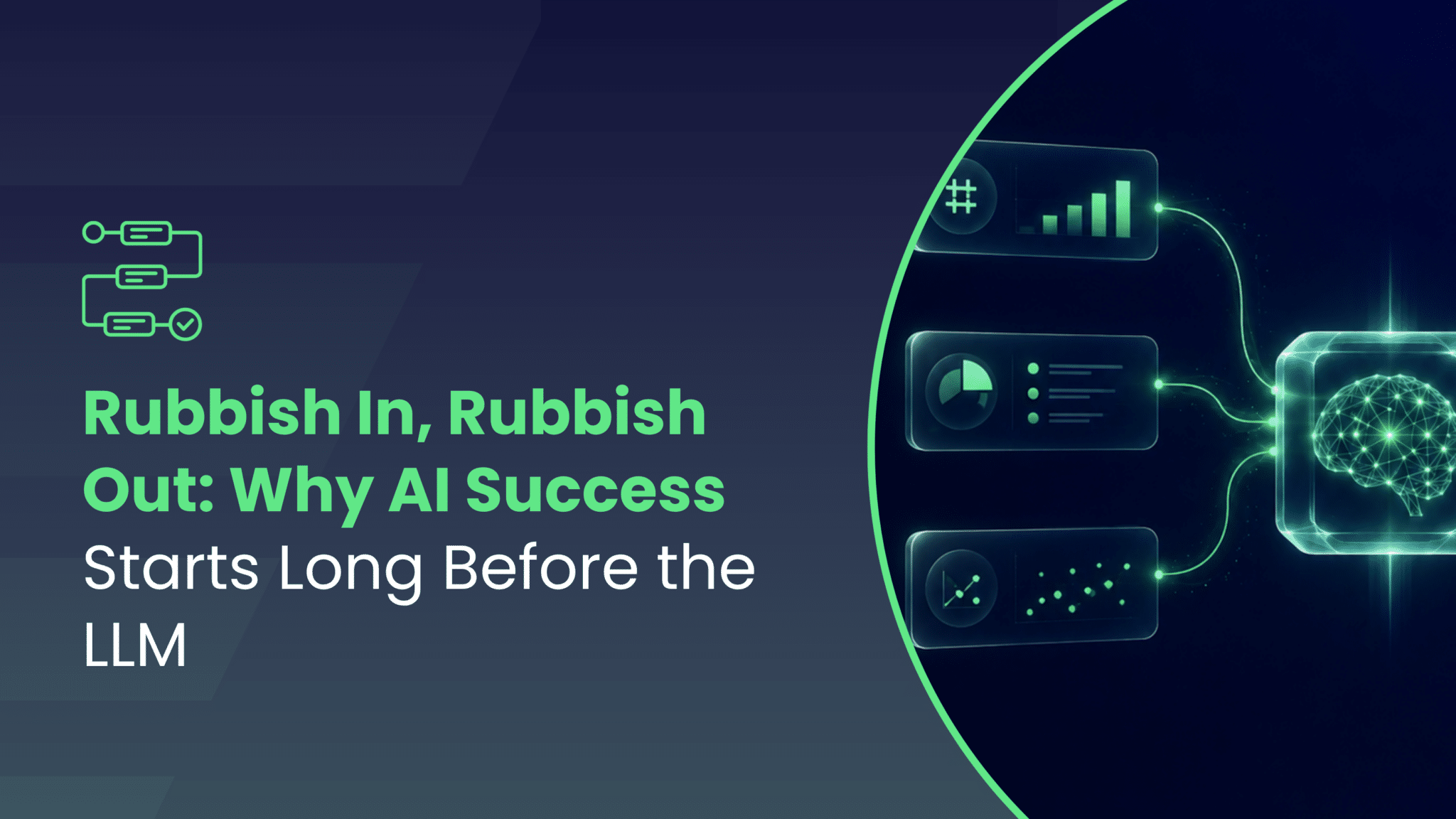
Simply put, if businesses feed AI messy inputs the AI simply scales that chaos. Clean data ensures accurate predictions and contextual recommendations, whereas disorganized data guarantees flawed guidance and wasted capital.
Sharpening the Axe: The Pre-AI Reality Check
There is an old adage that states if you give a man an hour to chop down a tree, he should spend the first 55 minutes sharpening his axe. The exact same logic must be applied when leveraging AI for business decisions.
You must spend the time upfront to ensure your data is accurate, well-organized, and rich in context before you ever prompt an LLM. Rushing to upload a raw, unverified CSV file into an AI platform is the equivalent of swinging a blunt axe at a massive oak tree. You will exert an incredible amount of energy, generate a lot of noise, and ultimately achieve absolutely nothing of value.
When an employee logs onto an AI platform, uploads an export from your ad accounts or CRM, and asks for a strategic roadmap, the AI will confidently spit out a highly detailed recommendation within seconds. The employee feels incredibly productive. They feel tech-savvy and certain of the output. However, they are completely unaware that they are handling a complete fabrication.
Think of AI like a highly paid, brilliant accountant. If you hand that accountant a shoebox full of inaccurate receipts, missing invoices, and flawed revenue numbers, they will still do the math. They will confidently hand you a completed tax return. But whose fault is it when the tax authorities come knocking? It is not the accountant’s fault. You provided bad information. AI operates the exact same way. If you give it inaccurate, disorganized information, you will get highly convincing but entirely incorrect outputs.
The Ecosystem Problem: Moving Beyond the CRM
When we talk about data hygiene, most business leaders immediately look at their CRM. The issue is much broader than a single software platform. You have to consider the entire revenue ecosystem. If the data is fragmented before it even hits your sales pipeline, your AI will be optimizing for the wrong targets from the very first click.
Here are the most common data traps across the revenue ecosystem:
- Ad Platform Chaos: Campaigns, ad groups, and creatives often lack a unified naming convention. If a campaign name does not clearly define the core strategy, the AI cannot accurately segment what is working and what is failing. It will lump distinct initiatives together and deliver a blurred, useless analysis.
- Missing Change Logs: A team member alters a core bidding strategy midway through the month, but this change is never documented in a way the AI can digest. The AI analyzes two months of data, assumes the strategy was identical the entire time, and delivers heavily skewed performance metrics based on a false premise.
- Broken Conversion Tracking: Leads are being counted twice, or unqualified top-of-funnel clicks are being tracked as bottom-of-funnel intent. The AI will immediately tell you to spend more capital on campaigns that generate worthless clicks because it cannot distinguish between high-intent actions and vanity metrics.
- Vague Pipeline Stages: Sales teams fail to update the software correctly, leaving deals lingering in the wrong stages. This turns your database into a graveyard for opportunity, actively teaching the AI to look for the wrong buying signals.
- Disconnected Financials: Revenue and gross profit figures are not accurately passed back to the marketing platforms. Without this vital feedback loop, the AI optimizes for cheap lead volume rather than profitable, sustainable growth.
The Negative Compounding Spiral
When these foundational errors exist, businesses fall into a highly dangerous trap. You feed bad data into your AI model. The AI gives you a bad recommendation based on that flawed data. Your team trusts the output, feels productive, and immediately actions the advice.
These actions push your marketing and sales efforts in the wrong direction, which generates even worse data. You then feed this new, degraded data back into the AI the following month to ask for next steps. Suddenly, things begin to compound negatively at an alarming speed. You are no longer just making simple operational mistakes. You are actively automating and scaling your own chaos.
The Pre-AI Standardization Protocol
To avoid this negative spiral, you need to standardize your patterns from the first ad click to the final closed deal.
If you are a frustrated business leader who wants to leverage AI this year, your first non-negotiable step on Monday morning is simple. Step back and imagine that the AI is an army of human consultants. If you handed them your current data exports, what questions would they ask? What gaps would they challenge you on?
You need a clear standardization checklist before you run a single prompt. Consider the following structural requirements:
| Data Source | The Hygiene Check | The Goal |
| Ad Platforms | Are all campaigns and creatives utilizing a strict, uniform naming convention? | Allows AI to accurately segment strategies, audiences, and creative angles. |
| Change Logs | Is there a documented history of major strategy shifts and budget allocations? | Prevents AI from attributing success or failure to the wrong variables. |
| CRM Pipeline | Are pipeline stages clearly defined, and is sales activity actively logged on time? | Ensures AI learns from actual winning behaviors rather than stalled or forgotten deals. |
| Financial Tracking | Are accurate gross profit numbers tied directly to the lead source? | Trains the AI to optimize for actual revenue, not just top-of-funnel lead volume. |
The Strategic Velocity Gap
If you ruthlessly tidy your data, you unlock a massive competitive advantage.
When your entire revenue engine speaks the same clean language, you trigger a positive compounding spiral. You can genuinely trust the AI’s strategic recommendations. When the tool tells you to pivot ad spend or focus on a specific buyer persona, you can execute that move with absolute confidence.
Furthermore, a clean system allows the AI to tell you exactly how to track the impact of the changes you just made. This ensures your next batch of data is even cleaner, making your next AI prompt exponentially more powerful.
The strategic FOMO is real. Competitors who ignore basic data hygiene will waste capital on advanced tools that deliver negative returns. The businesses that spend 55 minutes sharpening their axe will leverage AI to accelerate predictable, high-velocity growth that messy competitors can never replicate.