
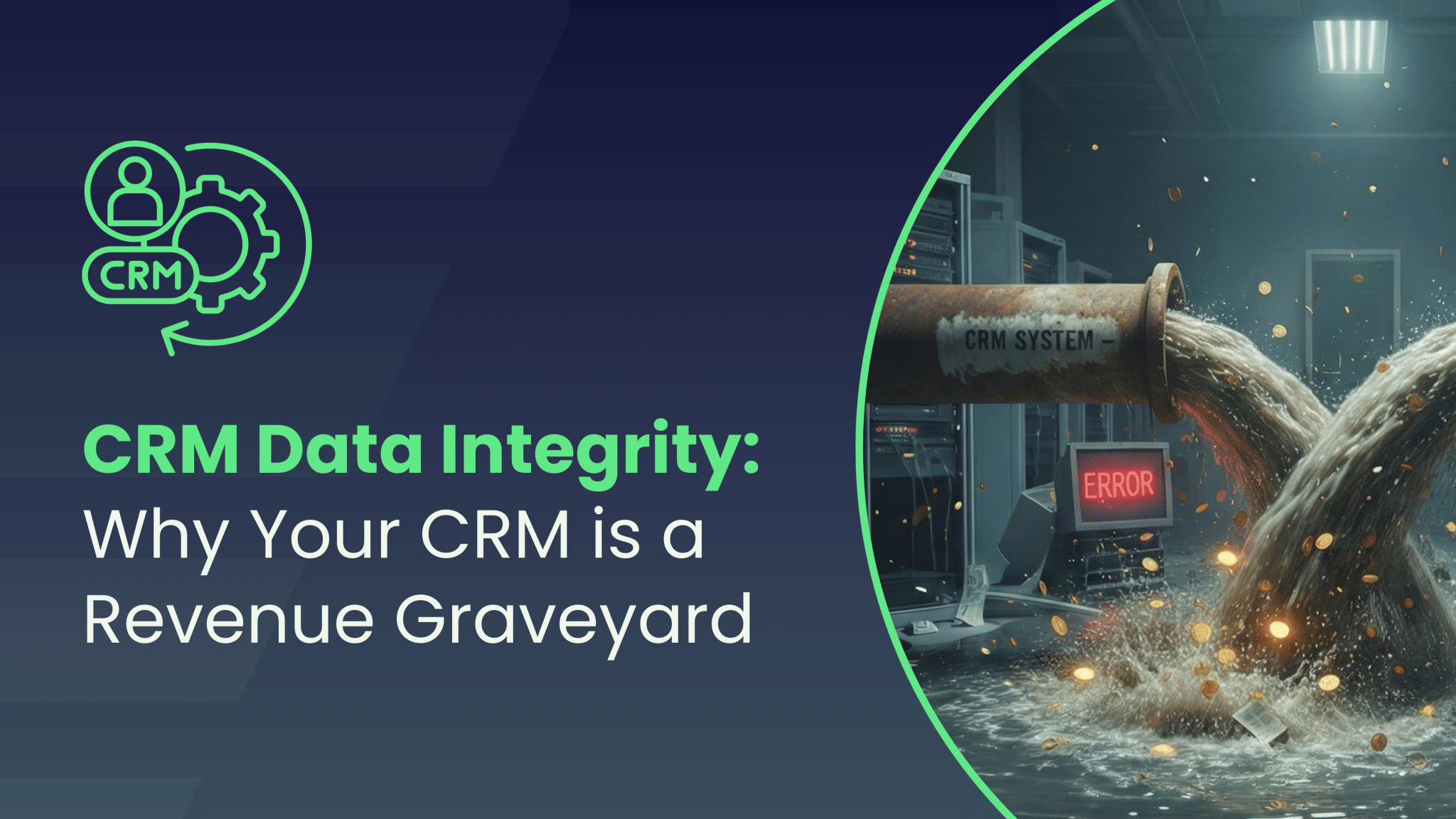
CRM data integrity is important for B2B companies because it transforms a stagnant database into a predictive revenue engine. High-quality data ensures that marketing spend targets real buyers, sales teams prioritize the highest-value opportunities, and leadership forecasts with financial precision. Without integrity, a CRM becomes a financial liability that masks systemic inefficiencies and results in significant lost revenue.
The Compounding Cost of the Invisible Leak
Most B2B leaders view a “messy” CRM as a minor administrative nuisance or a project for a quiet summer. This perspective is a fundamental strategic error. When data hygiene decays, the business begins to optimize for a reality that does not exist. You are likely spending significant customer acquisition costs (CAC) to reach contacts who have left their companies or to influence “opportunities” that were functionally dead six months ago.
The true danger is the compounding effect of these inaccuracies. If your lead routing is based on outdated firmographics, your best reps are fed low-tier “noise” while high-value signals vanish into the abyss of unassigned records. This creates a feedback loop of failure: marketing measures success based on inflated lead counts, while sales ignores the CRM because the data is unreliable. Eventually, the “rot” spreads from the database to the culture of the entire organization.
The Executive Origin of Data Decay
It is a common misconception to blame “lazy sales reps” for a CRM graveyard. While the input occurs at the frontline, the rot almost always starts at the executive level. CRM decay is rarely a software failure; it is a failure of data strategy. When leadership treats the CRM like a dusty old address book instead of a high-stakes bank account, the rest of the team will treat it like trash, too..
Top-tier competitors view their database with the same rigor as their balance sheet. In these high-performance environments, bad data is treated as a financial liability. They understand that a CRM should provide more than just contact info: it should provide product signals, pricing insights, and reliable forecasting. If you are not using your data to predict where your next million dollars is coming from, you are not managing an asset; you are maintaining a digital landfill.
Resurrecting the Gold in Your Database
The most immediate path to revenue recovery is not found in “new” leads, but in the resurrection of the “lost” ones. Imagine a mid-market firm that spent three years building a database of 50,000 contacts. Due to neglect, 40% of those records were incomplete or stale. By implementing an automated enrichment and re-engagement strategy, they identified “closed-lost” deals from two years prior where the primary contact had moved to a new, larger company.
The first move in this scenario is never manual cleanup. It is the implementation of automated firmographic enrichment. By layering third-party data over the existing graveyard, you can instantly surface “zombie” accounts that have recently received funding, changed leadership, or expanded their headcount. This turns a stagnant list into a prioritized “hit list” for your sales team, often revealing millions in “new” opportunities that were sitting in plain sight.
Making the Data Serve the Rep (Not the Other Way Around)
The traditional approach to CRM management relies on “compliance”, forcing reps to spend their Friday afternoons in an “admin hour” filling out endless text fields. This is a losing battle. To maintain data integrity, you must design for “flow” rather than “compliance.” The goal is to make the data serve the salesperson so they feel the immediate benefit of a clean system.
Automation and Intelligent Friction
High-velocity teams reduce manual entry through strategic automation. This includes:
- Automatic Logging: Emails and calls should be captured via integration, not manual typing.
- Behavioral Inference: Allow the system to infer stage changes based on activity (e.g., a sent proposal automatically moves the deal to “Negotiation”).
- Constrained Input: Use dropdowns and picklists exclusively. Free-text fields are where data goes to die.
- Conditional Logic: Only show fields when they are relevant to the current deal stage. Do not ask for “Budget” in the “Discovery” stage if it isn’t known yet.
The Incentives of Accuracy
Strategic leaders separate coaching from forecasting. If you weaponize the CRM to micro-manage every minute of a rep’s day, they will feed the system “junk” to satisfy the dashboard. Instead, celebrate clean loss reasons. Understanding exactly why a deal was lost is often more valuable for long-term strategy than a “committed” deal that never closes. When you reward accuracy over optimism, the integrity of your forecast stabilizes.
Strategic Blind Spots: The Competitive Gap
If your competitors are winning, it is likely because their data allows them to be more surgical. While your team is manually mining through old spreadsheets, top-tier firms are using their CRM data to:
- Optimize Lead Routing: Ensuring the right specialist gets the right lead in minutes, not days.
- Prioritize Outreach: Using “intent signals” to call the person most likely to buy today.
- Spotting the “Exit” Signs: Identifying patterns in customer behavior before the cancellation call happens.
If your CRM feels like a graveyard, it is because it has been treated as a destination for data rather than a starting point for action. By shifting the strategy from “tracking” to “enabling,” you stop the decay and begin to extract the hidden value already residing within your walls. Don’t make your reps serve the data. Make the data serve the reps.
Self Diagnosis: Your CRM Data Integrity
A CRM is either a graveyard for opportunity or a map for revenue. Use these five questions to determine if your data is working for you or if you are just working for your data.
5 Quick Questions:
-
- 🗹
Could you hand your CRM login to a stranger today and have them identify your three most likely deals to close this month without a verbal briefing? - 🗹
Does your sales team have a standardized “Data Dictionary” that ensures everyone defines a “qualified lead” or a “stalled deal” exactly the same way? - 🗹
Are your deal stages based on objective customer actions (like “Contract Received”) rather than subjective sales feelings (like “They seemed interested”)? - 🗹
When you look at your “Closed/Lost” data from six months ago, is there enough detail to launch a specific, targeted re-engagement campaign? - 🗹
Does your team trust the data in the CRM enough to use it as their primary daily “to-do list,” or do they still rely on side-spreadsheets and notebooks?
- 🗹
The Verdict:
- 4–5 “Yes” answers: You have Data Integrity. Your CRM is a high-fidelity asset that allows you to scale your sales team without scaling your chaos.
- 0–3 “Yes” answers: You have a Data Graveyard. You are likely losing 20–30% of your potential revenue to simple “forgetfulness” and administrative friction.